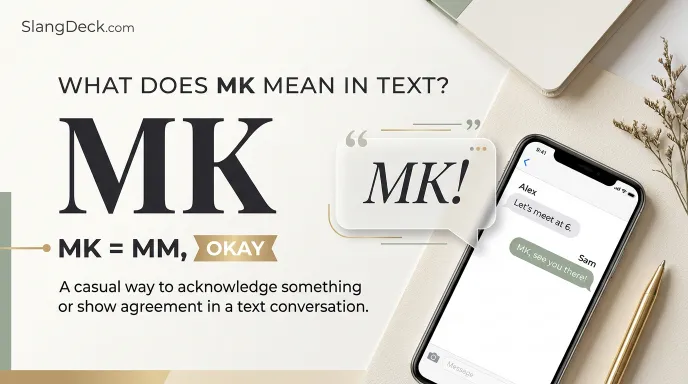
MK in text usually means “Mmm, okay” or simply “Okay.” People use it as a short response to show that they understand something, acknowledge a message, or agree without adding much detail. Depending on the conversation, it can sometimes sound neutral, uninterested, or slightly dismissive.
You may see MK in text messages, Snapchat chats, TikTok comments, Instagram DMs, and WhatsApp conversations. It is often used when someone wants to reply quickly instead of typing a complete sentence.
However, the tone behind MK is not always easy to understand. One person may use it casually, while another may send it because they are annoyed or do not want to continue talking.
In this guide, you will learn what MK means, how people use it on different platforms, and how to reply when someone sends it to you.
MK Meaning in Text
MK usually means “Mmm, okay” or “Okay.” It is an informal texting expression that people use to acknowledge information, respond to a statement, or show basic agreement.
For example:
Alex: “I’ll meet you outside the school at 4.”
Sam: “MK.”
Sam is acknowledging the plan. The reply does not necessarily show excitement, but it confirms that the message was received.
Unlike a simple “OK,” MK can sometimes feel a little more relaxed or less enthusiastic. Its tone depends on the relationship between the people and what they were discussing.
Is MK Slang or an Abbreviation?
MK is informal texting shorthand. It is commonly understood as a shortened way of writing “Mmm, okay” or “Okay.”
It is not a formal English word, and people generally use it in casual digital conversations rather than professional writing.
You might also see different versions, such as:
- MK: A short acknowledgment or okay.
- Mmk: A more expressive version of “Mmm, okay.”
- Mmmkay: A playful or drawn out way of saying “Okay.”
- Okay: The standard form without abbreviation.
These expressions can communicate similar ideas, but their tone may differ.
What Does MK Mean From a Girl or a Guy?
MK does not have a separate meaning based on the sender’s gender. A girl or a guy can use it simply to acknowledge a message.
For example:
You: “I’ll text you when I get home.”
Friend: “MK.”
This usually means the person understands.
Do not automatically assume someone is angry, upset, or losing interest just because they replied with MK. Look at the rest of the conversation before deciding what they mean.
Is MK a Dry Texting Response?
It can be. A short reply like MK may feel dry because it does not add much emotion or continue the conversation.
For example:
You: “I had such a great day today!”
Friend: “MK.”
This response might feel uninterested because it does not show much enthusiasm.
However, the person could simply be busy, distracted, or naturally brief when texting. One short message is not enough to understand someone’s feelings.
Where People Use MK
MK is mainly associated with informal digital communication. People may use it in private chats, group messages, comments, and everyday conversations.
Its basic meaning stays similar across platforms, but the surrounding message can change how it sounds.
MK Meaning on TikTok
On TikTok, MK may appear in comments, replies, and direct messages. Someone might use it to acknowledge a comment or respond to a suggestion.
For example:
User 1: “You should try this trend!”
User 2: “MK, I’ll give it a try.”
Here, MK means “Okay.” The person is acknowledging the suggestion.
It can also appear in conversations where someone wants to end a discussion without writing a long reply. However, the abbreviation itself does not prove that the person is annoyed.
MK Meaning on Snapchat
Snapchat conversations often involve quick replies, pictures, and short messages. MK fits naturally into this style of communication.
For example:
Alex: “I’ll send you the pictures later.”
Mia: “MK.”
Mia is simply acknowledging the message.
If a friend sends MK after a disagreement, it may sound less friendly or suggest that they do not want to continue discussing the issue. Still, the exact meaning depends on the situation.
MK Meaning on Instagram
On Instagram, people may use MK in direct messages and story replies.
Imagine that someone asks you to share a picture, and you reply:
“MK, I’ll send it tonight.”
Here, MK is a casual way of saying okay.
You might also see it in comment conversations when someone acknowledges another person’s point. It is usually more common in informal exchanges than in polished captions or professional posts.
MK Meaning on WhatsApp
WhatsApp users often send short messages when talking with friends, relatives, and classmates.
For example:
Sam: “Don’t forget to bring your notebook tomorrow.”
Leo: “MK, I won’t forget.”
The reply confirms that Leo understands the reminder.
In group chats, MK can also be used to acknowledge plans or instructions without starting a longer conversation.
MK Meaning in SMS Text Messages
In regular SMS messages, MK works as a short acknowledgment.
For example:
Mom: “Please call me when you reach home.”
Alex: “MK.”
Alex is saying that the message has been understood.
Because SMS conversations do not always include emojis or other tone clues, a short response can sometimes be misunderstood. If you want to sound warmer, you can write “Okay, sure” or “Got it!”
10 Real Chat Examples of MK
The following conversations show how MK may appear in everyday texting. Some examples show simple acknowledgment, while others demonstrate how the same reply can sound different depending on the situation.
Example 1: Making Plans
Alex: “Let’s meet at the coffee shop at 5.”
Mia: “MK, see you there.”
Alex: “Great!”
Meaning: Mia uses MK to acknowledge the meeting plan and confirm that she understands.
Example 2: Sending a Reminder
Sam: “Don’t forget to bring your assignment tomorrow.”
Leo: “MK, I’ll bring it.”
Sam: “Thanks!”
Meaning: Leo uses MK as a quick way to say okay.
Example 3: Talking About Homework
Emma: “The teacher said we need to finish questions 1 to 5.”
Olivia: “MK, I’ll do them tonight.”
Emma: “Same here.”
Meaning: Olivia acknowledges the information and confirms what she plans to do.
Example 4: Ending a Conversation
Ryan: “I have to go now. I’ll talk to you later.”
Daniel: “MK, take care.”
Ryan: “You too!”
Meaning: Daniel uses MK to show that he understands Ryan is leaving.
Example 5: Replying to a Suggestion
Mia: “You should watch that new series.”
Alex: “MK, I’ll check it out.”
Mia: “I think you’ll like it.”
Meaning: Alex acknowledges the recommendation and says he may watch the series.
Example 6: Discussing Dinner
Sam: “We’re ordering pizza tonight. Do you want some?”
Leo: “MK, get me a cheese pizza.”
Sam: “Sure!”
Meaning: Leo uses MK as a casual acknowledgment before placing his order.
Example 7: A Short Reply After an Argument
Emma: “I don’t want to argue about this anymore.”
Mia: “MK.”
Emma: “Let’s talk tomorrow.”
Meaning: Mia acknowledges the message. In this situation, the short reply may sound distant or suggest that she does not want to continue the discussion.
Example 8: Confirming a Time
Alex: “The bus leaves at 7:30, so be ready early.”
Sam: “MK, I’ll be there.”
Alex: “Don’t be late!”
Meaning: Sam confirms that he has understood the timing.
Example 9: Responding to Good News
Olivia: “I got a new phone today!”
Sophie: “MK, that’s nice.”
Olivia: “Thanks!”
Meaning: Sophie acknowledges the news. Her response may sound neutral rather than highly excited.
Example 10: Checking Availability
Daniel: “Are you free tomorrow afternoon?”
Ryan: “MK, why?”
Daniel: “I wanted to ask you something.”
Meaning: Ryan uses MK as a casual acknowledgment before asking for more information.
How to Reply When Someone Says MK
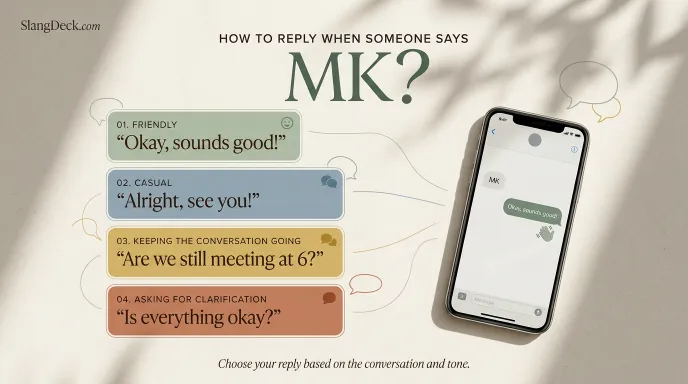
Your reply depends on what the other person is trying to communicate. Sometimes MK simply means they understand. In other situations, it may sound like they are not very interested in continuing the conversation.
You can respond naturally without making the situation complicated.
1. Funny Replies
If you are talking to a close friend, a playful response can keep things light.
- “Only MK? 😂”
- “That’s a very detailed reply!”
- “Okay, I see you’re saving your words.”
- “Your keyboard working today? 😂”
- “I’ll take that as a yes!”
Use these replies only when you are comfortable joking with the other person.
2. Casual Replies
If the conversation is normal, a simple response is enough.
- “Cool!”
- “Sounds good.”
- “Alright.”
- “Got it.”
- “No problem.”
These replies work well when both people are simply acknowledging information.
3. Friendly Replies
If you want to keep the conversation warm, try something a little more expressive.
- “Okay, talk to you soon!”
- “Great, thanks for letting me know.”
- “Perfect! See you then.”
- “Awesome, have a good day!”
- “Sure, take care!”
A friendly response can make a short conversation feel more natural.
4. Neutral Replies
If you do not know the person very well or want to keep things simple, use a polite answer.
- “Understood.”
- “Okay, thanks.”
- “That works.”
- “Alright, noted.”
- “Sure.”
You do not need to ask what MK means every time. If the message is clear, you can simply continue the conversation.
5. What If MK Sounds Rude?
If someone sends MK after an argument or an important discussion, you may feel that they are being dismissive.
Instead of immediately assuming they are angry, you can ask:
- “Is everything okay?”
- “Did I say something wrong?”
- “Are you upset about something?”
- “Do you want to talk about it later?”
A calm question is usually better than responding with another short or angry message.
Is MK Rude or Offensive?
MK is not generally considered a rude or offensive abbreviation. Its usual purpose is to acknowledge something or say okay.
However, its short and sometimes flat tone can make it sound uninterested, especially when the conversation is emotional or important.
Is MK Safe to Use With Friends?
Yes. You can use MK with friends in casual conversations.
For example:
Friend: “I’ll pick you up at 6.”
You: “MK, thanks!”
This is a normal informal response.
If you want to sound more excited or friendly, you can add a few words or an emoji.
Is MK Appropriate at School?
MK may be fine in casual messages between classmates. However, it is better to use complete words when messaging teachers or discussing schoolwork formally.
For example:
Informal: “MK, I’ll finish the assignment.”
More appropriate: “Okay, I will finish the assignment.”
The second response is clearer and more suitable for school related communication.
Is MK Appropriate at Work?
MK is generally better suited to informal workplace chats than formal emails.
If you are communicating with a manager, customer, or professional contact, use expressions such as:
- “Understood.”
- “Okay, thank you.”
- “That works for me.”
- “I will take care of it.”
These responses sound clearer and more professional.
Who Uses MK?
MK can be used by people of different ages who communicate through text messages and social media. It is not limited to one generation or one particular online community.
People may choose it because it is short, easy to type, and suitable for quick conversations.
Does Gen Z Use MK?
Some Gen Z users use short replies such as MK, OK, K, and other informal expressions when texting friends.
However, MK is not exclusive to Gen Z. Older users and people from different age groups may also understand or use it.
The way someone texts is often influenced by personal habits, relationships, and the type of conversation.
Which Platforms Are Associated With MK?
You may come across MK in:
- Snapchat messages
- TikTok comments and DMs
- Instagram conversations
- WhatsApp chats
- SMS text messages
- Discord and other online communities
These platforms support quick informal communication, which makes short replies convenient.
How Often Does MK Appear Online?
MK is recognizable as an informal way to acknowledge a message, but it is not always used by everyone. Some people prefer “OK,” “okay,” “sure,” or “got it.”
Its frequency can vary across communities and personal texting styles. It is best to understand it as a casual expression rather than assume it is one of the most popular internet abbreviations.
Origin of MK
There is no clearly documented origin for MK as a texting abbreviation. It is difficult to identify the first person or online platform that introduced it.
One likely explanation is that it developed from the everyday use of “Mmm, okay” or “Okay” in spoken and written conversations.
People often shorten familiar expressions when communicating online. This habit became especially useful as text messaging and instant chat grew more common.
The spelling “MK” may represent a quick acknowledgment without typing the complete word. Similar short responses, such as “K” and “OK,” have also become familiar in digital communication.
However, it would be inaccurate to claim that MK originated on Snapchat, TikTok, or any specific social media platform without reliable evidence.
Today, people may use it in private messages, group chats, and other informal online conversations. Its tone can change depending on the situation, which is why context matters.
MK Compared With Other Common Texting Abbreviations
MK is one of many short expressions used in everyday digital conversations. Other abbreviations, such as IDK, IDC, IMO, and BRB, have different meanings and purposes.
The table below explains how they compare.
| Abbreviation | Meaning | Type | Usage | Popularity |
| MK | Mmm, okay / Okay | Informal shorthand | Acknowledging a message or showing agreement | Less common than OK |
| IDK | I Don’t Know | Initialism | Expressing uncertainty | Very common |
| IDC | I Don’t Care | Initialism | Showing a lack of concern or preference | Very common |
| IMO | In My Opinion | Initialism | Sharing a personal opinion | Common |
| BRB | Be Right Back | Initialism | Saying you will return shortly | Very common |
MK vs. IDK
IDK means “I Don’t Know.” It is used when someone does not know the answer to a question.
Example:
Alex: “Where is the nearest supermarket?”
Sam: “IDK, maybe near the main road.”
MK is different because it usually acknowledges information rather than expressing uncertainty.
MK vs. IDC
IDC means “I Don’t Care.” It can show that someone has no preference or does not feel concerned about something.
Example:
Mia: “Should we watch a comedy or an action movie?”
Emma: “IDC, you choose.”
MK generally communicates acknowledgment or agreement, not a lack of concern.
MK vs. IMO
IMO stands for “In My Opinion.” People use it when sharing a personal view.
Example:
Alex: “IMO, this design looks better.”
MK does not introduce an opinion. It is more commonly used as a short acknowledgment.
MK vs. BRB
BRB means “Be Right Back.” It tells someone that the sender is temporarily leaving the conversation.
Example:
Sam: “BRB, I need to answer the door.”
MK does not mean someone is leaving. It simply acknowledges a message or communicates agreement.
Real World Usage Example
Imagine that two classmates are discussing a school project through WhatsApp. One student sends a message explaining when they will meet and what they need to bring.
Ayesha: “Let’s meet at the library tomorrow at 3. Bring your notes too.”
Sara: “MK, I’ll bring everything.”
Ayesha: “Great. See you tomorrow!”
In this situation, MK simply means “Okay.” Sara understands the plan and confirms that she will bring the notes.
Now imagine that two friends are having a disagreement.
Alex: “I don’t think we should discuss this right now.”
Sam: “MK.”
Here, the same abbreviation may sound less friendly because of the emotional context. Sam might be agreeing, feeling annoyed, or simply ending the discussion.
This shows why you should consider the complete conversation instead of judging someone’s feelings from one short reply.
Common Misunderstandings About MK
Because MK is so short, people can sometimes misunderstand its tone or purpose. Here are a few common mistakes.
1. Thinking MK Always Means Someone Is Angry
MK can sound dry, but it does not automatically mean the sender is upset. They may simply prefer short messages or be busy.
2. Assuming MK Is the Same as K
Both can be used as short acknowledgments, but their tone may feel different. MK can represent “Mmm, okay,” while K is usually a shortened form of “Okay.”
3. Thinking MK Is Always a Positive Response
MK usually acknowledges a message, but it does not necessarily show excitement. If someone wants to express enthusiasm, they might use “Absolutely!” or “Sounds amazing!”
4. Assuming MK Is Flirty
MK is not normally a romantic expression. It can appear in conversations between friends, relatives, classmates, or coworkers.
5. Confusing MK With a Name or Initials
In some contexts, MK may represent a person’s initials, a brand, or another abbreviation. If it appears in a conversation about a specific subject, the meaning could be different.
Always use the surrounding words to understand what the sender intends.
Frequently Asked Questions
What does MK mean in text messages?
MK usually means “Mmm, okay” or simply “Okay.” It is an informal way to acknowledge a message, confirm information, or show basic agreement.
What does MK mean on TikTok?
On TikTok, MK may appear in comments or direct messages as a short acknowledgment. It generally means “Okay,” although the tone depends on the conversation.
Is MK slang?
Yes. MK is informal texting shorthand. People use it in casual digital conversations instead of typing a complete response.
Is MK rude or offensive?
No, MK is not inherently rude or offensive. However, it can sometimes sound dry or uninterested because it is such a short response.
How should you reply to MK?
You can reply with “Okay,” “Sounds good,” “Got it,” or “No problem.” If the message seems cold or unusual, ask politely if everything is alright.
Does MK mean Mmm, Okay?
Yes. MK is often understood as a shortened version of “Mmm, okay.” It can show that someone has heard or accepted what another person said.
Does MK mean Okay?
Yes. In casual texting, MK is commonly used to mean “Okay” or to acknowledge information.
Why does someone reply with MK instead of OK?
Some people prefer short texting expressions. They may use MK out of habit, convenience, or to give a casual acknowledgment. It does not always indicate a particular emotion.
Does MK mean someone is annoyed?
Not necessarily. A short reply can sometimes sound annoyed, but the sender may simply be busy or communicating briefly. Consider the conversation before assuming anything.
Conclusion
MK usually means “Mmm, okay” or simply “Okay” in text messages. People use it to acknowledge information, respond to suggestions, and confirm plans without writing a full sentence.
You may see it on Snapchat, TikTok, Instagram, WhatsApp, and regular SMS messages. Although it is generally harmless, it can sometimes sound dry or uninterested depending on the situation.
Use it freely in casual conversations with friends, but choose complete and professional expressions when messaging teachers, managers, or clients.
Most importantly, remember that MK does not automatically mean someone is angry or upset. The surrounding conversation is the best way to understand its tone.
Discover More Articles

Hi, I’m Sarah. I studied Communications at the University of Texas and have spent the last six years writing about internet culture and Gen Z slang across TikTok, Twitter, and everyday conversations. I focus on real usage, not just dictionary definitions.