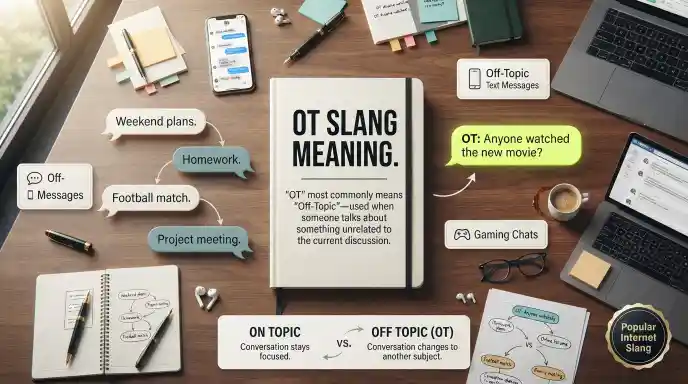
OT slang meaning most commonly refers to “off-topic,” which is used when someone says or posts something unrelated to the current conversation or discussion. However, OT can also have other meanings depending on the platform, community, or context, making it a commonly searched internet abbreviation.
You may see OT in text messages, Reddit threads, Discord servers, online forums, gaming chats, workplace conversations, and social media comments. Understanding the context is important because the abbreviation does not always mean the same thing.
In this guide, you’ll learn the different meanings of OT, where it is commonly used, when to use it, and real-life examples to help you understand it correctly.
Quick Answer for OT Slang Meaning
OT most commonly stands for “off-topic,” meaning something that is unrelated to the current discussion. In some contexts, it can also mean overtime, occupational therapy, or other terms, depending on the conversation.
What Does OT Mean in Text?
In texting and online conversations, OT usually means “off-topic.” People use it when a message, comment, or question does not relate to the subject everyone is discussing.
For example, if a group is talking about a football match and someone suddenly asks about vacation plans, another person might reply, “That’s OT.” This lets everyone know the conversation has moved away from the original topic.
On discussion platforms like Reddit, Discord, and online forums, users may also write “OT:” before a message to show they are intentionally introducing a different subject.
Although off-topic is the most common slang meaning, OT may have different definitions depending on where it appears. Always consider the context before deciding what it means.
Examples
- OT, but did you watch the new movie last night?
- Let’s stay on topic. That question is OT.
- Sorry for going OT, I have one quick question.
- Your comment is a little OT for this discussion.
Full Form / Definition of OT Slang
Unlike many internet abbreviations, OT does not have just one meaning. Its definition changes depending on the conversation and platform.
Here are the most common meanings:
| Full Form | Meaning | Common Context |
| Off-Topic | Something unrelated to the current discussion. | Texting, Reddit, Discord, forums |
| Overtime | Extra working hours or extra time in sports. | Workplace, sports |
| Occupational Therapy | A healthcare profession that helps people improve daily living skills. | Medical discussions |
| Off Track (less common) | Someone has moved away from the main subject or goal. | Casual conversations |
When people search for OT slang meaning, they are almost always referring to Off-Topic, especially in online chats and social media.
Is OT Slang Rude, Offensive, or Neutral?
OT is generally neutral and is not considered rude or offensive. It simply points out that a message does not match the current topic of conversation.
The tone depends on how it is used.
Friendly
Friends often use OT casually without offending anyone.
Example:
OT, but your new profile picture looks great!
Helpful
Moderators or group members may use OT to keep discussions organized.
Example:
Please keep this thread on topic. OT comments may be removed.
Slightly Negative
If someone repeatedly tells another person their comments are OT, it can sound dismissive or unfriendly, especially in heated discussions.
Example:
That’s completely OT. Please stay on topic.
Overall, OT is a polite internet abbreviation when used respectfully.
Where Is OT Slang Commonly Used?
The abbreviation OT appears across many online platforms where people communicate quickly.
Text Messages
Friends may use OT when changing the subject during a conversation.
Reddit users often label comments as OT when discussing something unrelated to the original post.
Discord
Gaming communities and servers frequently use OT to keep chat channels organized.
Online Forums
Many forums ask users to avoid OT discussions so conversations stay relevant.
Social Media
People occasionally use OT on platforms like X (formerly Twitter), Facebook, and Instagram when making unrelated comments or starting a new topic.
Workplace Chats
In Slack, Microsoft Teams, or other work messaging apps, OT may indicate an off-topic discussion or, depending on the context, overtime.
Real Life Examples of OT Slang Meaning
The meaning of OT depends on the conversation, but when it means off-topic, it is usually used to point out that someone has changed the subject. Here are some real-life examples in different situations.
Friendly Conversation
Friends often use OT when they want to ask an unrelated question without interrupting the main discussion.
Examples:
- OT, but did you finish the new Netflix series?
- Sorry for going OT, but I need your advice.
- OT question, what phone do you use?
Casual Chat
In everyday texting, OT helps people smoothly switch to another subject.
Examples:
- That’s a little OT, but I have something to tell you.
- We can discuss that later because it’s OT.
- Let’s finish this topic first before going OT.
Gaming Context
Gaming communities use OT to keep chats focused on the game.
Examples:
- Keep the chat game-related. That’s OT.
- Take OT conversations to the general channel.
- Let’s stay focused on the match, no OT messages.
Social Media or Forums
Online communities often use OT to organize discussions.
Examples:
- OT: Does anyone know a good photo editing app?
- This comment is OT for this thread.
- Please avoid OT discussions here.
Origin and Background of OT Slang Meaning
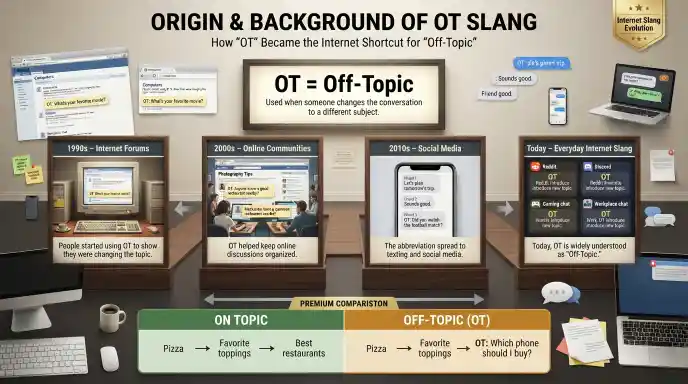
The abbreviation OT became popular long before today’s social media platforms. It was widely used on internet forums, bulletin board systems (BBS), mailing lists, and chat rooms during the 1990s and early 2000s.
As online communities grew, moderators needed an easy way to identify comments that did not relate to the main discussion. Users began writing “OT” or “OT:” before their messages to show they were introducing a different subject.
When social media, Reddit, Discord, and messaging apps became popular, the abbreviation spread even further. Today, OT remains one of the most common internet shortcuts for off-topic because it is short, easy to type, and widely understood.
Comparison with Similar Slang
Although OT means off-topic, several other internet abbreviations serve different purposes. Knowing the difference can help you avoid confusion.
| Slang | Meaning | When It’s Used |
| OT | Off-Topic | When a message is unrelated to the discussion |
| BTW | By the Way | To introduce an additional thought |
| FYI | For Your Information | To share useful information |
| TBH | To Be Honest | To express an honest opinion |
| IMO | In My Opinion | To share a personal viewpoint |
| IRL | In Real Life | To distinguish real life from online life |
While BTW introduces a related side note, OT clearly tells readers that the next message is outside the current topic.
When to Avoid Using OT Slang
Although OT is harmless, it is not appropriate in every situation.
Avoid using it when:
- Writing formal emails.
- Preparing academic assignments.
- Creating business reports.
- Speaking in professional presentations.
- Communicating with clients or customers.
In formal situations, writing “This is unrelated to our current discussion” sounds clearer and more professional than simply saying OT.
You should also avoid using OT if you think the other person may not understand internet slang. Writing the complete phrase off-topic helps prevent confusion.
Polite Alternatives to OT
If you want to sound more professional or respectful, you can replace OT with clearer expressions.
Some good alternatives include:
- Off-topic
- Unrelated
- Changing the subject
- On a different note
- While we’re discussing something else
- By the way
- A separate question
- Before I forget
These alternatives work well in professional emails, classroom discussions, and workplace conversations where internet abbreviations may seem too informal.
Why Do People Use OT Slang?
People use OT because it is a quick way to let others know that a message is not related to the current discussion. Instead of writing “this is off-topic,” they simply type OT, saving time while keeping conversations organized.
Common reasons people use OT include:
- To introduce a different topic.
- To ask a quick unrelated question.
- To keep online discussions organized.
- To help moderators manage conversations.
- To make chats easier to follow.
Because it is short and widely recognized, OT remains popular in online communities.
Impact of Using OT in Communication
Using OT can improve communication when it is used appropriately. It helps readers understand that a conversation is changing direction and prevents confusion in long discussions.
Positive Effects
- Keeps discussions organized.
- Makes topic changes clear.
- Saves time while texting.
- Helps moderators manage online communities.
Possible Drawbacks
- Some people may not know what OT means.
- Using it too often can interrupt the flow of conversation.
- It may sound abrupt if used without a polite explanation.
When used respectfully, OT helps make online communication clearer and more organized.
Is OT Safe for Social Media?
Yes. In most cases, OT is completely safe to use on social media because it simply means off-topic. It does not contain offensive language or inappropriate content.
You can commonly see OT on:
- Discord
- X (formerly Twitter)
- Online forums
- Gaming communities
However, remember that OT can also mean overtime or occupational therapy in different contexts. Always consider the conversation before assuming its meaning.
Common Misunderstandings About OT Slang Meaning
Many people misunderstand OT slang meaning because the abbreviation has several definitions. Here are some common misconceptions:
OT always means “Off-Topic.”
Not always. While Off-Topic is the most common slang meaning, OT can also mean Overtime, Occupational Therapy, or other terms depending on the context.
OT is offensive slang.
No. OT is generally a neutral abbreviation and is not considered rude or offensive.
OT is only used on social media.
Incorrect. It is also common in text messages, online forums, Discord servers, Reddit, gaming chats, and workplace messaging apps.
OT can be used in formal writing.
It’s better to avoid OT in formal emails, reports, or academic writing. Writing “off-topic” in full is more appropriate.
Every OT means the same thing.
Always look at the conversation. The surrounding context determines if OT means Off-Topic, Overtime, or something else.
Key Takeaways
- OT slang meaning most commonly stands for “Off-Topic.”
- It is used when someone changes the conversation to an unrelated subject.
- OT is widely used in texting, Reddit, Discord, online forums, gaming chats, and social media.
- The abbreviation is neutral and is generally not considered offensive.
- Depending on the context, OT may also mean Overtime or Occupational Therapy.
- Understanding the conversation helps you identify the correct meaning of OT.
- In formal communication, it’s usually better to write “off-topic” instead of using the abbreviation.
Frequently Asked Questions
What does OT stand for in slang?
In internet slang, OT most commonly stands for off-topic, meaning a message or comment is unrelated to the current discussion.
Is OT only used online?
No. While OT is most common in online chats, people also use it in workplace messaging apps, text messages, and casual conversations.
Is OT rude?
No. OT is generally a neutral expression. It only becomes impolite if it is used in a dismissive or disrespectful way.
What does OT mean in gaming?
In gaming chats, OT usually means off-topic and is used when someone talks about something unrelated to the game or match.
Can OT have other meanings?
Yes. Depending on the context, OT can also mean overtime, occupational therapy, or other terms. The surrounding conversation usually makes the meaning clear.
Should I use OT in formal writing?
No. In formal emails, reports, or academic writing, it is better to write off-topic or unrelated instead of using the abbreviation.
Conclusion
OT slang meaning most commonly refers to off-topic, a simple abbreviation used to show that a message is unrelated to the current discussion. It is widely used in texting, Reddit, Discord, gaming communities, and social media because it helps keep conversations organized and easy to follow.
Although OT is generally neutral and safe to use, its meaning can change depending on the context. Understanding the conversation before using or interpreting OT will help you communicate more clearly and avoid misunderstandings.
Explore Related Articles:

Hey, I’m Jordan. I grew up in a bilingual household in LA, so Spanish and Mexican American slang has always been part of how I talk. I’ve been writing online content for five years, explaining terms the way I’d explain them to a friend meaning, tone, and when it’s actually okay to use.